Remedies & Treatments — Historical Research Library

Search Remedies & Treatments Across 200 Years of Homeopathic Literature

Explore primary sources from over 200 years of homeopathic literature. Search remedies, treatments, and clinical passages — every result traces directly to its original printed page.

247Books
94,000Passages indexed
312Remedies catalogued
Pages indexed
200+Years of literature
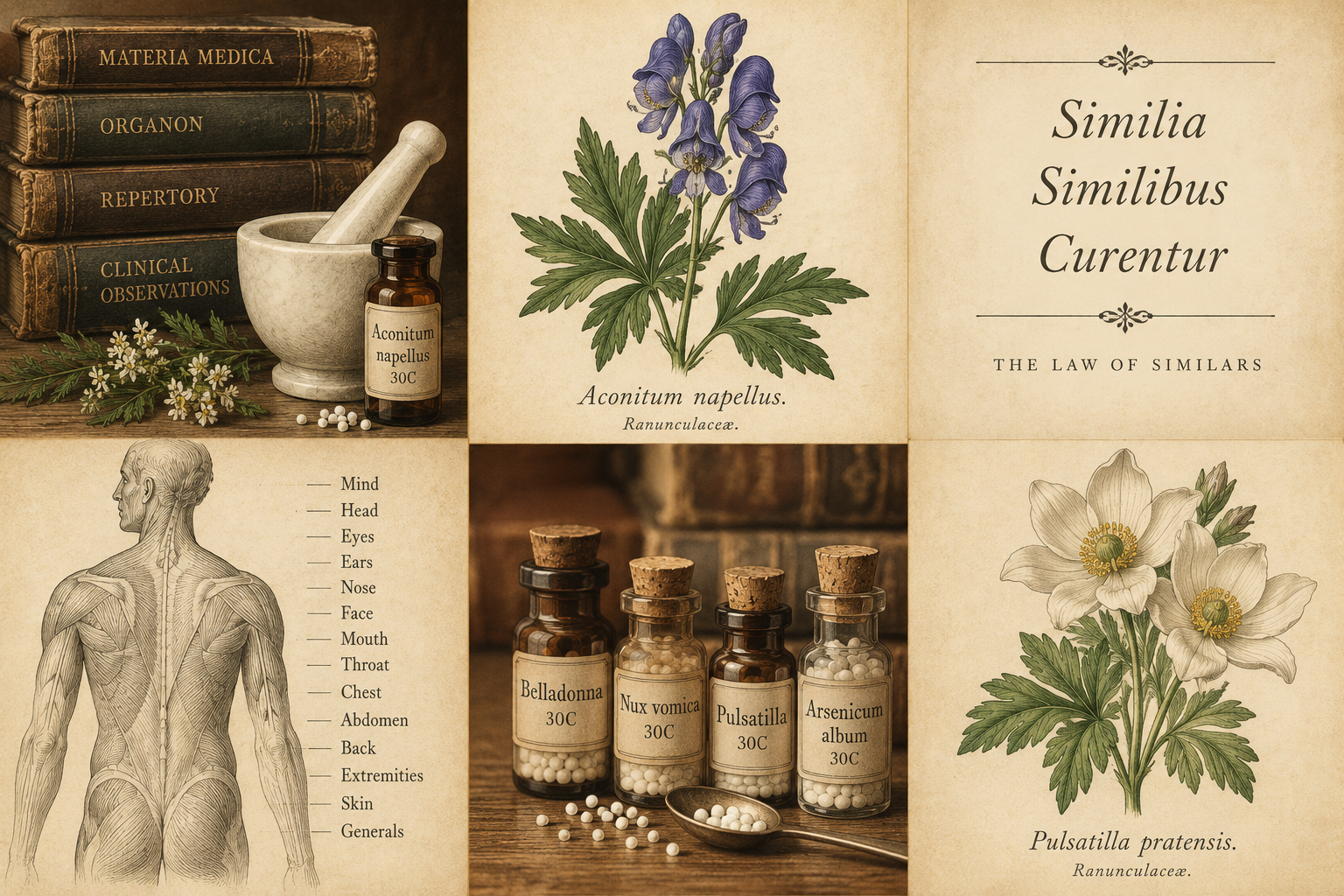
A vintage collage of historical homeopathic texts including Materia Medica, Organon and Repertory, botanical illustrations of Aconitum napellus and Pulsatilla pratensis, remedy bottles of Belladonna, Nux vomica, Pulsatilla and Arsenicum album, an anatomical diagram, and the Latin motto Similia Similibus Curentur — the Law of Similars

How to Search

Keyword & Phrase Search

Search for exact words or phrases as they appear in the original texts. Use quotation marks for precise phrase matching. Fuzzy matching handles OCR variations and historical spellings automatically.

Natural-Language Search

Describe a symptom, concept, or clinical picture in plain language. The library uses semantic search to surface historically relevant passages even when the original text uses different terminology.

Remedy Search

Search by remedy name — full Latin name, common name, or abbreviation. Results are drawn from across the entire library and grouped by book and author, with every passage linked to its source page.

Treatment Search

Search for the treatment of a specific condition or disease. Historical authors frequently dedicated entire sections to treatment protocols, dosage guidance, and the selection of indicated remedies for acute and chronic complaints.

Example Results

The following are illustrative examples showing how search results appear. They are drawn from real historical texts.

"The patient is worse from every motion, even the slightest. He desires to lie perfectly still. The headache is bursting, splitting, aggravated by the least movement of the eyes or head, and relieved by firm pressure."
Lectures on Homoeopathic Materia Medica
James Tyler Kent, 1905
Printed p. 138PDF p. 142
Match: Matched: 'motion', 'movement', 'headache', 'pressure' — semantic match on aggravation pattern
Aconitum NapellusView source
"Great restlessness, tossing about; the patient cannot remain in any position. Fever comes on suddenly, with great heat, dry skin, and intense thirst for cold water. Fear and anxiety accompany the febrile state."
The Chronic Diseases, Their Peculiar Nature and Their Homoeopathic Cure
Samuel Hahnemann, 1835
Printed p. 47PDF p. 51
Match: Matched: 'restlessness', 'fever', 'heat' — semantic match on acute febrile picture
Drosera RotundifoliaView source
"A dry, spasmodic, barking cough, worse after midnight, compelling the patient to hold the sides. The cough is excited by a tickling in the larynx and is frequently accompanied by retching or vomiting."
A Dictionary of Practical Materia Medica
John Henry Clarke, 1900
Printed p. 712PDF p. 718
Match: Matched: 'dry cough', 'night', 'barking' — keyword match on cough modality
Treatment — Whooping CoughView source
"In the treatment of pertussis, Drosera stands pre-eminent in the spasmodic stage. Where the paroxysms are violent and end in vomiting, Ipecacuanha will frequently cut short the attack. Cuprum metallicum is indicated when the spasms are of a convulsive character with rigidity of the limbs."
A Dictionary of Domestic Medicine
John H. Clarke, 1910
Printed p. 203PDF p. 209
Match: Matched: 'treatment', 'whooping cough', 'pertussis' — keyword match on treatment protocol

This library is a historical research resource. The texts presented are primary sources from the 18th–20th centuries and do not constitute medical advice. All passages are reproduced verbatim from their original sources.

Homeopathic Library

A digital archive of primary historical homeopathic literature. Every passage is reproduced verbatim from its original printed source and traceable to the original scanned page.

© 2026 Homeopathic Library. All rights reserved.

This library is a historical research resource. Texts are primary sources from the 18th–20th centuries and do not constitute medical advice.